Showing posts with label Tax Law. Show all posts

Proposal of The Union Budget 2012-2013 to amend the Income Tax Act retrospectively w.e.f. April 1, 1962 to bring under net all overseas transactions involving domestic assets


Vodafone case in a Nutshell:
In February, 2007 Vodafone (through its Netherlands entity) entered into an agreement with Hutchison Telecommunications International Limited, Cayman Islands (‘HTIL’), for acquisition of 66.9848% equity and interests in the Indian telecom business of Hutchison Essar Ltd. (hereinafter referred to as ‘HEL’).  The total value of the transaction was $ 11.206 billion.
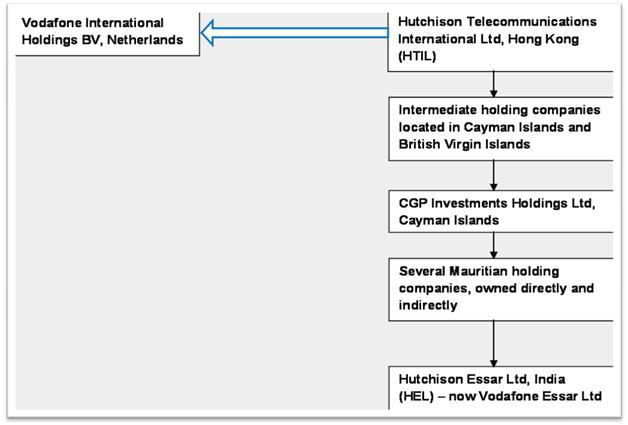


Since the transfer of the Indian telecom firm's shares and assets to Vodafone had led to capital gains for Hutch, the IT department demanded capital gains tax from Vodafone, which was liable to withhold this tax from the amount they paid Hutch. Vodafone claimed the transaction was not liable to tax since it was achieved by transferring the shares of a Cayman Island-based holding company and did not involve the transfer of a capital asset situated in India.

The High Court rejected this contention by holding that “The essence of the transaction was a change in the controlling interest in HEL which constituted a source of income in India. The Petitioner (Vodafone) by the diverse agreements that it entered into has a nexus with Indian jurisdiction. In these circumstances, the proceedings which have been initiated by the Income Tax Authorities cannot be held to lack jurisdiction.” 
Vodafone has filed an appeal before the Supreme Court against Bombay High Court decision.
The Hon’ble Supreme Court vide its order dated January 20, 2012 decided the issue in favour of Vodafone and held that Vodafone was not liable to withhold any tax because no capital gains arose in the said transaction which would be chargeable to tax in India. The Hon’ble Supreme Court mainly observed as follows:  

·         Section 9 covers only income arising through a transfer of a capital asset situated in India; it does not purport to cover income arising from the indirect transfer of capital asset in India. If the word indirect is read into Section 9(1)(i), it would render the express statutory requirement of Section 9(1)(i) nugatory.
 
·         Situs of shares situates at the place where the company is incorporated and / or the place where the shares can be dealt with by way of transfer.
 
·         Section 195 would apply only for payments made from a resident to a non-resident, and not between two non-residents situated outside India.
 
·         The entire transaction has been carried out outside India and in relation to property which is situated outside India. It involves transaction between two non-residents in respect of shares of a company incorporated outside India. Therefore, the Indian Tax Authorities have no territorial tax jurisdiction over the said transaction.

Proposed Amendment in Union Budget 2012-13 - A Retrograde Step

The Government in its zest to establish superiority of legislature over judiciary has now proposed the following major amendments in the Income-tax law retrospectively from 01st April, 1962:
·     In section 9(1)(i), to clarify that the word “through” in the said section shall mean and include “by means of”, “in consequence of” or “by reason of”. This explanation has been inserted with an intent to provide that the income arising from indirect transfer of capital asset shall also be included in section 9(1)(i).
 
·       In section 2(14), to clarify that the term “property” includes any rights in or in relation to an Indian company, including rights of management or control or any other rights whatsoever.
 
·         In section 2(47), to clarify that ‘transfer’ includes disposing of or parting with an asset or any interest therein, or creating any interest in any asset in any manner whatsoever, directly or indirectly, absolutely or conditionally, voluntarily or involuntarily by way of an agreement (whether entered into in India or outside India) or otherwise, notwithstanding that such transfer of rights has been characterized as being effected or dependent upon or flowing from the transfer of a share or shares of a company registered or incorporated outside India.
 
·       In section 9(1)(i), to further clarify that “situs of shares” of a company incorporated outside India shall be deemed to be in India if the share derives, directly or indirectly, its value substantially from the assets located in India.
 
·         In section 195, to provide that it will also cover payments made by a non-resident to another non-resident. It has been further clarified that the said provision will apply whether or not the non-resident has a residence or place of business or business connection or any other presence in any manner in India.

Tax Law

Shri Parshottam Parkash Vs CST, Delhi (Dated: March 29, 2011)

Service Tax - 80 year old appellant with no independent income states that he has no concern whatsoever with the firm charged with liability to pay Service Tax - Pre-deposit waived: the averments raised by the appellant need to be decided on merits by the appellate authority in view of the issue raised by the appellant with regard to his liability. The impugned order has been passed on a prima facie view of the appellate authority. Keeping in view the averments raised by the appellant and the fact that he is an aged person of about 80 years and has no source of income of his own and the fact that he has already deposited a sum of Rs.5.00 lakhs as a pre-deposit for hearing the appeal, the pre-deposit order of an additional amount of Rs.20.00 lakhs is not justified. In the given circumstances, the impugned order is set aside to the extent of asking for the pre-deposit of Rs.20.00 lakhs.: DELHI HIGH COURT;


Bharat Sanchar Nigam Ltd Vs CCE, Vadodara (Dated: January 27, 2011)

Service Tax - Short payment of service tax by BSNL due to difference between Cash Account Summary and the Sub-ledger revenue - Appellants claim that in some months, there were excess payments and in some months, there were short payments - Matter remanded to adjust the excess payments against the short payment and quantify the service tax payable - Penalty set aside. : AHMEDABAD CESTAT;

Tax Law

International Sufi Centre Vs DIT, Bangalore (Dated: January 25, 2011)

Income Tax - Section 80-G - Whether when assessee preaches Sufism, a part of Islam religion, it can even then claim Sec 80G benefits as a charitable organisation. - Assessee’s Appeal dismissed: KARNATAKA HIGH COURT;

CIT, Bangalore Vs M/s Expert Outsource (P) Ltd (Dated: March 1, 2011)

Income Tax - Sections 10A, 143(3) - Whether Sec 10A benefits are available even after an existing unit is converted into STPI Unit. - Revenue’s appeal dismissed: KARNATAKA HIGH COURT;

CIT, Bangalore Vs M/s Deccan Creations Pvt Ltd (Dated: January 31, 2011)

Income Tax - Section 115JAA& 234B, 234C - Whether MAT credit can be given before charging interest u/s 234B and 234C. - Revenue's appeal dismissed: KARNATAKA HIGH COURT;


Cartini India Ltd Vs ACIT, Mumbai (Dated: March 16, 2011)

Income Tax - Sections 143(3), 147, 148 - Whether reopening of an assessment completed under section 143(3) of the Act is permissible merely on the basis of new opinion formed on the same material which happened to be the material of Sec 143(3) assessment.- Assessee's appeal allowed: MUMBAI ITAT;

M/s Stratcap Securities (I) Pvt Ltd Vs DCIT, Mumbai (Dated: February 25, 2011)

Income Tax - Section 37 - Whether expenses incurred for fixing doors and other structures in a rented premises are capital in nature - Whether climatic conditions entitle an assessee for some percentage of such expenses - Assessee's appeal partly allowed: MUMBAI ITAT;

Direct Tax

BOMBAY HIGH COURT

The Commissioner of Income-tax Vs. Shri Bharat R. Ruia (HUF) Phoenix Mills Premises (Decided on 18.04.2011)

Direct Taxation - Speculation loss - Assessee (HUF), engaged in the business of trading in shares and securities, entered into certain derivative transactions which resulted in loss - Assessee claimed said loss as business loss - Assessing Officer (AO) rejected said contention of the assessee and held that the loss incurred was speculation loss covered under Section 43(5) of the Income Tax Act, 1961

(a) Whether the transactions in exchange traded financial derivatives were 'speculative transactions' as defined in Section 43(5) of the Act, 1961?

Held, Section 43(5) of the Act provides that a transaction for purchase/sale of any commodity would be a speculative transaction if it was settled otherwise than by actual delivery - For the purposes of Section 43(5) of the Act, it was not necessary that the commodity agreed to be purchased or sold must be capable of actual delivery - In the instant case, the assessee had entered into futures contracts for purchase of shares of certain companies at a specified future date and at a specified price, which were to be settled in cash without actual delivery of the shares - Future contracts for purchase / sale of an underlying security permitted to be traded on the stock exchange and settled otherwise than by actual delivery would be speculative transactions under Section 43(5) of the Act - Hence, the exchange traded derivative transactions carried on by the assessee during Assessment Year 2003-04 were speculative transactions covered under Section 43(5) of the Act

(b) Whether clause (d) inserted to the proviso to Section 43(5) of the Act w.e.f. 1.4.2006 would apply to such transactions undertaken in the Assessment year 2003-04

Held, firstly, the legislature by Finance Act, 1995 had specifically provided that clause (d) to the proviso to Section 43(5) of the Act shall come into operation prospectively w.e.f. 1.4.2006 - Secondly, insertion of clause (d) was not necessitated on account of the fact that the provisions of Section 43(5) of the Act were unworkable - Thirdly, even after insertion of clause (d) in Section 43(5) of the Act, all transactions in derivatives were not taken outside the purview of Section 43(5) of the Act - It was only those derivative transactions which were covered under clause (d) were taken outside the purview of Section 43(5) of the Act and the rest of the transactions in derivatives would continue to be covered under Section 43(5) of the Act - Hence, contention of assessee that clause (d) inserted to the proviso to Section 43(5) of the Act had retrospective effect could not be accepted - Clause (d) inserted to the proviso to Section 43(5) of the Act w.e.f. 1.4.2006 was prospective in nature and could not apply to transactions undertaken in the Assessment Year 2003-04- Impugned order of the Tribunal set aside - Revenue's appeal allowed.

Post your Comments / Feedback : CLICK HERE